Sales office :
No 398, Middle Tongjiang Road, Xinbei District, Changzhou City, 213022, Jiangsu, China
+86-519-85133978

 |


| CAS: | |
|---|---|
| MF: | |
| Formula: | |
| Toxicity: | |
| Shelf Life: | |
| Quantity: | |
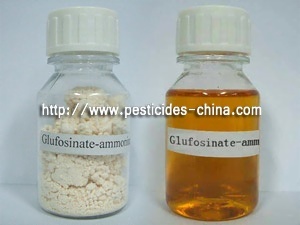
Glufosinate 95% TC, 15%SL(W/V) 20%SL(W/V) 50%TC(W/V)
Good-Job
Description
| Product kind | Herbicide |
| Common Name | Glufosinate |
| Chemical name | (2RS)-2-amino-4-[hydroxy(methyl)phosphinoyl]butyric acid |
| Molecular Formula | C 5H 12NO 4P |
| Molecular Weight | |
| CAS Registry Number | 9008-02-0 |
| Properties: | Crystalline solid, with a slightlypungent odor. |
| Uses: | Glufosinate-ammoniumis used for control of a wide range of annual and perennial broad-leaved weedsand grasses in fruit orchards, vineyards, rubber and oil palm plantations,ornamental trees and bushes, non-crop land, and pre-emergence in vegetables.Also used as a desiccant in potatoes, sunflowers, etc. For control of annualand perennial weeds and grasses in glufosinate-tolerant crops (oilseed rape,maize, soya beans, sugar beet) developed through gene technology. |
| Toxicity: | The oral LD50 is 436-464 mg/kg in mice and 1,510-1,660 mg/kg in rats. Dogs are the most sensitive. They can be twice as susceptible as mice (the LD50 for beagles is 200-400 mg/kg). The LD50 of the surfactant, AES, is 1,995-2,138 mg/kg in rats |
| Type of formulation: | 95% Tech 15%SL(W/V) 20%SL(W/V) 50%TC(W/V) |
| Packing Details | 25kgs/drum or according to customers' demand |
Uses as Herbicide:
Used in Crops: fruit orchards, vineyards, rubber and oil palm plantations, ornamental trees and bushes, non-crop land, and pre-emergence in vegetables. glufosinate-tolerant crops(oilseed rape, maize, soya beans, sugar beet)
Target weeds : annual and perennial broad-leaved weeds and grasses
Desiccant: potatoes, sunflowers, etc.
Toxicity:
Acute oral LD50 for male rats 2000mg/kg, female rats 1620mg/kg,
Acute percutaneous LD50 for male rats >4000mg/kg, female rats > 4000 mg/kg